
Your Marketing Isn't Working Because You're Skipping The Most Important Step
Written by: Sini Hietaharju, Wellness Travel Marketing Specialist
This post is part of
series
It's Sunday night.
You're scrolling Instagram, seeing yet another wellness entrepreneur announce their sold-out retreat. You feel a knot in your stomach.
You have the expertise, the passion, the beautiful offer... but your posts feel like whispers in a storm.
You try a Reel. You write a caption.
You feel a pang of 'salesy' cringe and delete it. The cycle repeats.
This isn't a problem of effort. It's not that you aren't talented.
The problem is that you're trying to build a house without a blueprint.
That blueprint is your marketing plan. It’s not a corporate monster. It’s a living, breathing document that gives you clarity, confidence, and clients.
Below, I’ll walk you through the exact 9-step process to create yours. I’ve even turned it into a free downloadable template so you can follow along.
How to Create a Marketing Plan for Your Wellness Business
This guide will tell you exactly How to Create a Marketing Plan for Your Wellness Business
What a Marketing Strategy Really Is (And Isn't)
What it's NOT: It’s NOT a 50-page corporate document.
It’s NOT about being on every platform.
It’s NOT a rigid set of rules that kills your authenticity.
What it IS: Frame it as your business's guiding light.
Your Filter: It tells you what to say NO to, so you can say YES to what works.
You can stop this constant back-and-forth on "should I be on TikTok?", "Is this right topic on my blog?" and this general confusion.Your Confidence: It turns "I think I should..." into "I know I will."
As a content plan, you have this level of clarity: I know I will share a client's transformation story on Tuesday because it speaks directly to my ideal client's fear of burnout.Your Alignment Check: It ensures every post, page, and email feels like you and speaks to your ideal client.
All you create comes from a WHY, from a deeper purpose and therefore feels like you and speaks directly to your ideal client's heart. It removes the "cringe" factor because you're communicating with purpose.Your confusion remover when you have a clear plan in place
I would dare to say, that a marketing strategy replaces guesswork with guidance, and panic with a plan.
I am sure you know the consuming feeling of re-inveinting the marketing wheel, the guilt of again having a week go by without posting any marketing updates about your work, as it feels salesy, or going inconsistent with your inspiration on what to share.
The 3 Things Happening When You Market Without a Plan
1. You're Exhausting Yourself: Chasing trends = burnout.
Chasing every trend and posting inconsistently is a recipe for burnout. You're pouring energy into a leaky bucket. Every random act of marketing depletes your creative reserves, leaving you with less energy for the healing work you love.2. You're Attracting the Wrong People (or No One): Unclear messaging attracts mismatched clients.
If you're talking vaguely about "stress relief," you'll attract everyone from overworked CEOs to overwhelmed students, most of whom aren't right for your specific offering. This leads to frustrating discovery calls, price haggling, and a feeling that people just "don't get it."3. You're Leaving Money on the Table.
Inconsistent, confusing marketing makes your incredible offer look like a "nice-to-have" instead of a "must-have." When you lack a clear narrative, you fail to build the perceived value and urgency that turns "maybe later" into "I need this now." Your revenue stays unpredictable.
Step 1: Define Your Business Objectives (The 'Why' Before the 'How')
START WITH YOUR DESTINATION AND YOUR MAP
This step answers two critical questions:
A: Where are you going? (Your Business Objectives)
B: How will you know you're getting there? (Your KPIs & Starting Point)
PART A: START WITH SETTING THE GOAL (OBJECTIVES)
A marketing plan may sound boring and slightly unnecessary paperwork before doing "the actual work" of doing the Instagram ad, writing the caption and planning your offer.
However, skipping this step will keep you lost and confused, just like the ideal client on your website: not recognising themselves from the wellness copywriting and ending up not buying.
Ask yourself what are your short-term and long-term goals?
Good ways to set the goals are to use the common marketing measurements, like revenue, amount of clients, amount of leads, amount of traffic on website.
Helpful questions:
What’s your 12-month revenue goal?
How many retreats do you want to sell?
Do you want to launch an online course?
Use the SMART goal setup, because vague goals, like "get more clients" lead to vague marketing that simply does not work anymore.
PART B: AUDIT YOUR STARTING POINT & SET KPIS (THE 'MEASURE')
Know Your Numbers to Grow Your Numbers
Now, translate that big "Why", or your destination, into trackable numbers. This is where you use the template's "Starting state" and "KPIs" sections.
Step-by-step actionable guidance to set your Goals & KPIS:
First, Audit Your "Starting State": In your template, write down where you are right now. Be honest.
Email list size: ______
Monthly website visitors: ______
Instagram followers: ______
Average monthly retreat inquiries: ______
Current revenue: ______
This is your baseline. You can't measure progress if you don't know your starting line.
Then, Set Your Marketing KPIs: These are the key performance indicators that prove your marketing is working toward your business objectives. They must be SMART.
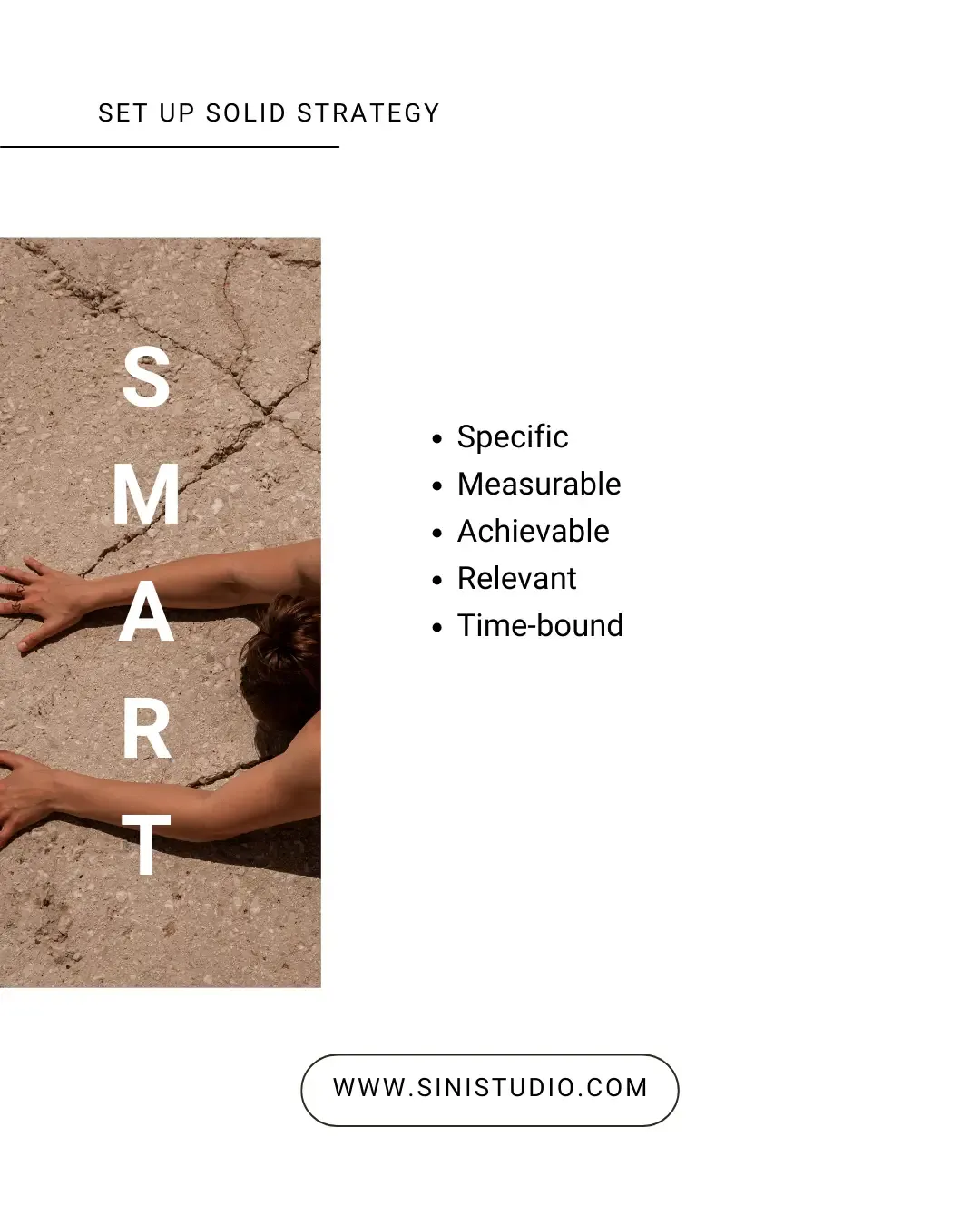
A SMART goal is Specific, Measurable, Achievable, Relevant, and Time-bound. For a wellness business, avoid vague goals like "get more clients."
Example of a BAD goal: "Grow my email list."
Example of a SMART goal: "Increase my email list by 200 subscribers (from wellness retreat leads) by running a free 'Pre-Retreat Calm Guide' opt-in campaign on Instagram and my website within the next 90 days."
This works because:
Specific: 200 subscribers from retreat leads.
Measurable: You can track the number.
Achievable: Based on your reach and resources.
Relevant: Grows your audience for future retreats.
Time-bound: 90 days.
PRO TIP: Start with your revenue goal and work backwards to set marketing KPIs (like list size or leads needed) that make it achievable.
PRO TIP: Your KPIs are your marketing machine's fuel gauge. Review them monthly. Are you on track? If not, you adjust your plan (Step 5) before you miss your big annual goal.
This combined step is your antidote to "leaving money on the table." It moves you from hopeful wishing ("I want more clients") to strategic execution ("I need 30 inquiries, so I will focus my marketing on X to achieve that"). It creates accountability and turns your marketing plan from a document into a measurable roadmap to revenue.
This stops you from chasing
Step 2: Get Crystal Clear on Your Ideal Client (The 'Who')
WHY “EVERYONE” IS YOUR BIGGEST MARKETING PROBLEM
I know we say yoga is for all, and of course I agree this world would be a better place if everyone would commit to breathwork, annual retreat or a little yoga flow consistently.
This is the reason why I hear so many healers and yoga teachers say that they do not want to "niche down" or restrict their offering to only certain kinds of people.
Ideal customer persona is not "everybody" and it's neither "45-year-old stressed woman"
But the idea is not just to talk about random, made-up demographics, like women between 40-50, but it's about defining whose problem we can solve best.
So if you keep your yoga being for everyone, the one with back pain may not fully benefit from it, as it's too general. The person with anxiety does not 100% heal either, as it's just a "basic yoga class".
The person seeking to build a consistent yoga routine doesn't see a purpose of maintaining this practice, which does not answer her why.
So let's forget for a while about writing random files, with the help of AI that says, my ideal client is a 45-year-old woman who is stressed and busy.
But let's dwell into what kinds of problems they may be having.
For example, transplant surgeons are not defining their ideal clients based on their demographics.
They are defining the exact problem they are having and how to solve it in the best possible way.
This is exactly why you want to know your ideal customer as well.
Only then can you give them ease, relief and wellbeing, when you are not feeling like kinda, sort-of, maybe, but your offering feels like "oh my god, it's made exactly for me!"
What makes a 45-year-old stressed woman feel like the offer is custom-made for them
Let’s use this example of “a 45-year-old stressed woman” for a bit longer, as it seems to be the target audience of many wellness businesses.
Although it may not be demographically wrong, and it may sound specific, it does not really give you tools on how to talk to them.
Maybe their core problem is rather feeling guilty of taking time for self-care?
And the desired transformation would be permission to prioritise their wellbeing without guilt.
This is already a much easier angle to start talking in a natural, approachable and relatable way to your target audience, than something vague and generic, like “are you stressed again”, right?
So, defining the Ideal Customer Persona based on their pain points, goals, attitudes and values instead of AI-written, assumed demographics will help you eventually sell your soulful offerings.
Knowing who you talk to directly solves the pain of "attracting the wrong people or no one."
Step 3: Craft Your Core Messages (The 'What' You Say)
FROM VAGUE TO “MADE FOR ME!”
If you really took your time to define the Ideal Customer Persona, focusing on their Values, Pain Point, Attitudes and Motivators in life instead of only demographics, you can craft some killer messages that actually feel like a direct convo with their soul, and sell your services.
This is the part where the copy of all your marketing starts to speak to your ideal client, instead of just being nice words.
This step is about positioning (what makes you uniquely valuable in their eyes) and your core message (the one powerful promise you deliver). It's where you translate your service into the language of their transformation.
Message hooks by target group = The magnetic phrases that stop their scroll.
Your task for the Messaging hooks section of the marketing strategy for wellness business is to brainstorm 2-3 short, powerful, benefit-driven phrases.
Imagine them as Instagram headlines or the tagline on your website banner.
What would make your ideal client nod and say, "Yes, that's exactly what I need"?
These message hooks will be the backbone of all your content marketing from now on.
Pro Tip: If you have a brand story (that should be the “About” page on your website) and your Ideal Customer Persona, you can use these two together with the help of AI to come up with the Core Messaging Hooks.
AI is a great tool even for soulful marketing, IF used correctly and with relevant data about your business.
This process eliminates the "salesy cringe" because you're no longer "selling yoga" or "selling coaching." You are offering a recognized solution to a deeply felt problem.
You're speaking their language, not industry jargon. When your message is this aligned, it doesn't feel like marketing, it feels like a welcome invitation. This is how you attract clients who are not just interested, but who feel seen and are ready to say "yes."
Read more detailed help for the Ideal Customer Persona from How to Define your Wellness Client Persona
Step 4: Position and distinction: Your unique value statement
STAND OUT IN A CROWDED WELLNESS WORLD
You have your message hooks—the quick, punchy lines that grab attention. Now, we need the foundational statement that those hooks are built on. This is your "Position and Distinction": a clear, compelling answer to the question, "Why should I choose you over anyone else?"
Think of it as your elevator pitch for your ideal client's heart.
It's not a list of your certifications (though those matter).
It's the unique blend of your methodology, your story, and the specific result you create that no one else can replicate in quite the same way.
Use this formula to craft your unique value statement
A strong positioning statement follows this logic:
I help [YOUR IDEAL CLIENT] who struggle with [THEIR SPECIFIC PAIN/FRUSTRATION] to [ACHIEVE DESIRED TRANSFORMATION/OUTCOME] through [YOUR UNIQUE APPROACH OR PHILOSOPHY].
Or you can also try:
I help [IDEAL CLIENT] achieve [DESIRED OUTCOME] by [YOUR UNIQUE METHOD/SOUL], unlike others who [WHAT'S GENERIC/DIFFERENT ABOUT THEM].
For example, this is how a retreat leader can position themselves:
Generic Competitor: "We offer yoga retreats in beautiful locations."
Your Unique Positioning Statement:
"I help sensitive, creative women who feel drained by constant giving to rediscover their inner spark and creative voice through immersive, story-based retreats that weave yoga, nature, and creative writing into a personal pilgrimage, unlike standard retreats that focus only on physical relaxation."
For example, this is how a breathwork facilitator can talk to business clients:
Generic Competitor: "I provide breathwork and coaching for professionals."
"I help high-achieving entrepreneurs dissolve chronic stress and prevent burnout through a 'boardroom to mat' somatic framework that merges evidence-based nervous system science with pragmatic mindset tools, unlike generic wellness coaching that lacks strategic business integration."
Okay, these are cool, optimal, AI-written examples. I highly recommend using more personalized tone-of-voice and vocabulary, like you were talking to a good friend.
So cut the picture-perfect, ideal slogan into more approachable language.
For example, mine at SINI STUDIO is:
I help confused wellness entrepreneurs who struggle with technical uncertainty and marketing confusion reach their ideal clients with confidence and clarity through a clear, step-by-step approach to marketing based on long-term strategy and SEO, rather than random quick fixes and unreliable platforms like Instagram.
Knowing who you talk to directly solves the pain of "attracting the wrong people or no one."
Helpful questions to write your brand positioning:
Look at Your "Message Hooks" (Step 3). What core promise do they hint at?
Look at Your "Ideal Client" (Step 2). What is their ultimate transformation?
Now, fill in the "Position and distinction" box of the wellness marketing strategy template. Answer these questions:
What is your unique approach or philosophy? (e.g., "story-based immersion," "science-backed somatic frameworks," "ritual over routine").
What specific result do you specialise in creating? (e.g., "rediscovering creative voice," "sustainable performance," "nervous system mastery").
How is this different from what's already out there? (Don't bash others; simply highlight your unique angle).
Pro Tip: Your "Why" is Your Superpower
Your distinction often lives in your brand story. That is your personal journey.
For example, for me, it’s not just my background working in SEO full-time, RYT-500 certification and Master’s degree specialising in wellness tourism.
But it’s also my Finnish practical thinking, combined with the trials and errors of finding my business core.
I ended up from SEO to Yoga Teacher to Travel Blogger to teaching others the best ways to do marketing, when I realised I am more of a Marketeer than a Yoga Teacher in the end.
I know the pain of a conceptual issue, and how it eats your confidence, when you are not sure what exactly you stand for, when your calling still feels somewhat unaligned.
The moment I found the clarity on mixing and matching my experiences and my knowledge, it all clicked.
I don’t need to be a Yoga Teacher, but I don’t either need to do Marketing for industries that my soul does not care about. That’s why my calling is to help spread yoga and healing services to the world with the help of my marketing (My whole story here).
So it’s okay for you as well to tell your “messy” background and how your specific combination of knowledge and experience has developed over the years.
That unique background is your distinction.
Weave a thread of it into your statement.
Why This Matters- This statement does the heavy lifting. It:
Guides All Your Brand Decisions: From website copy to service packages.
Attracts Your Tribe: It resonates deeply with your perfect clients and repels the wrong fits.
Gives You Unshakeable Confidence: When you know exactly what you stand for, "imposter syndrome" fades. You're not just another wellness practitioner; you're the specialist for a specific transformation.
This is the core of your "Solid Setup." Everything you build: your website, your content, your offers, will radiate from this clear position.
Step 5: Map Out Your Marketing Machine (The 'How' & 'When')
BUILD YOUR CONSISTENT MARKETING ENGINE
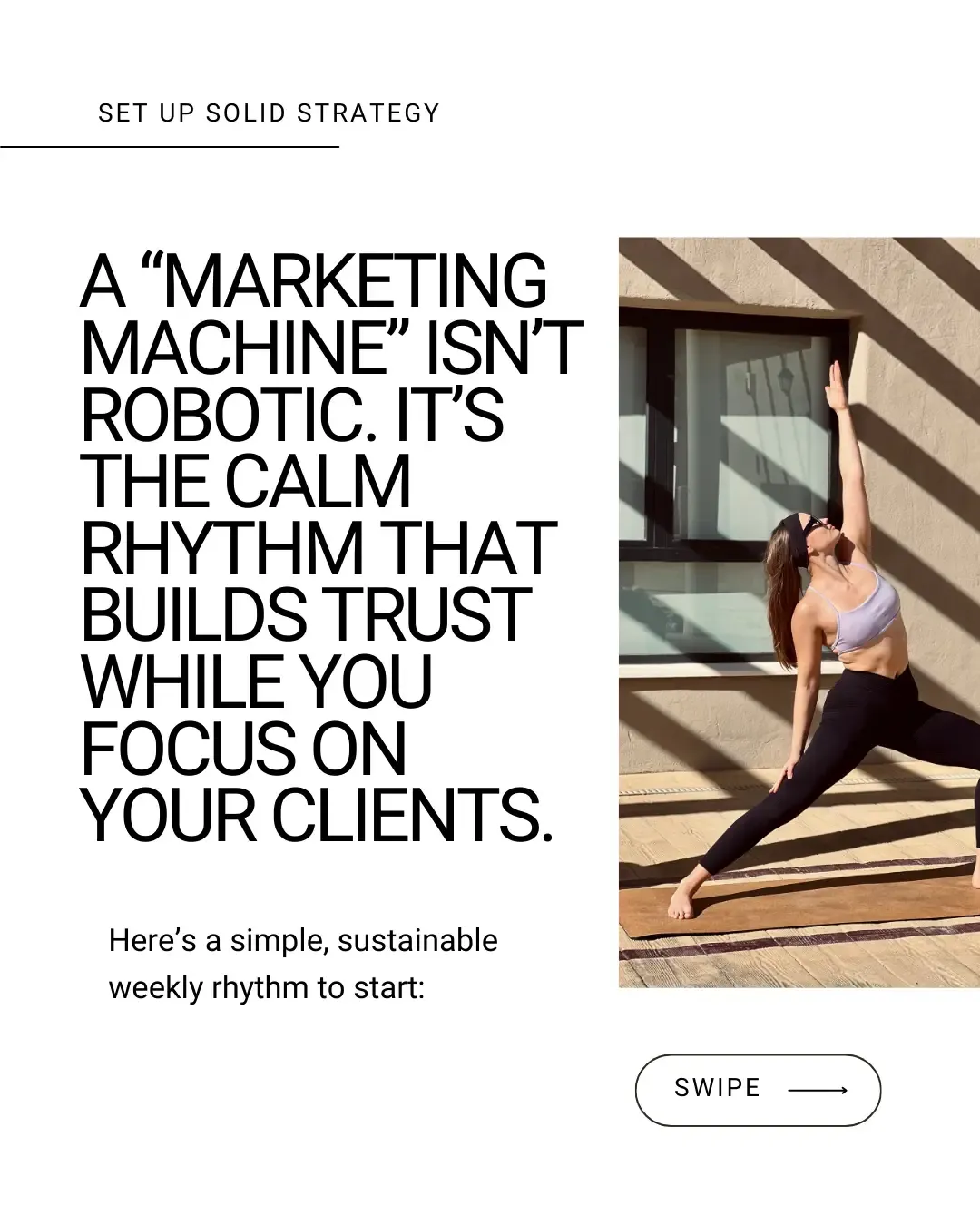
This is the heart of the plan, where your strategy becomes action. A "marketing machine" isn't a cold, robotic thing—it's your calm, repeatable rhythm that builds trust and attracts clients while you focus on your healing work.
It’s the system that turns "What should I post?" into "I know exactly what to do today."
Step 5A: Choose Your Channels (The 'Where')
Don't be everywhere. Be strategic. Based on your Ideal Client (Step 2), ask:
Do they seek inspiration visually? → Pinterest & Instagram are your hubs for mood and transformation.
Do they research solutions deeply? → Your Blog & SEO are non-negotiable for retreat leads.
Do they value connection and trust? → Email Newsletter is your #1 owned asset for building relationships.
Action: In the "Channels and means" section of the free template, list 2-3 primary channels. For each, define its role and goal.
Example for Retreat Leader:
Pinterest: Role: Inspire with retreat visuals & drive SEO traffic to blog. Goal: 500 monthly blog visitors from Pinterest.
Email Newsletter: Role: Nurture leads with personal stories & retreat updates. Goal: Build a list of 500 passionate subscribers.
Example for Established Coach:
LinkedIn: Role: Establish authority with strategic posts for professionals. Goal: Generate 2 consultation calls per month.
Blog/SEO: Role: Answer detailed questions about stress & performance. Goal: Rank on page 1 for "somatic tools for executives."
Why This Matters- This statement does the heavy lifting. It:
Why This Matters- This statement does the heavy lifting. It:
Step 5B: Define Your Content Rhythm (The 'When')
Consistency beats random bursts of "perfect" content. Your rhythm is your sanity.
Action: Open the "Example week" and "Example month" tables.
1. First, block your "CEO Time": In the monthly view, mark the week you'll plan content and the day you'll review your KPIs.
2. Now, fill the weekly rhythm.
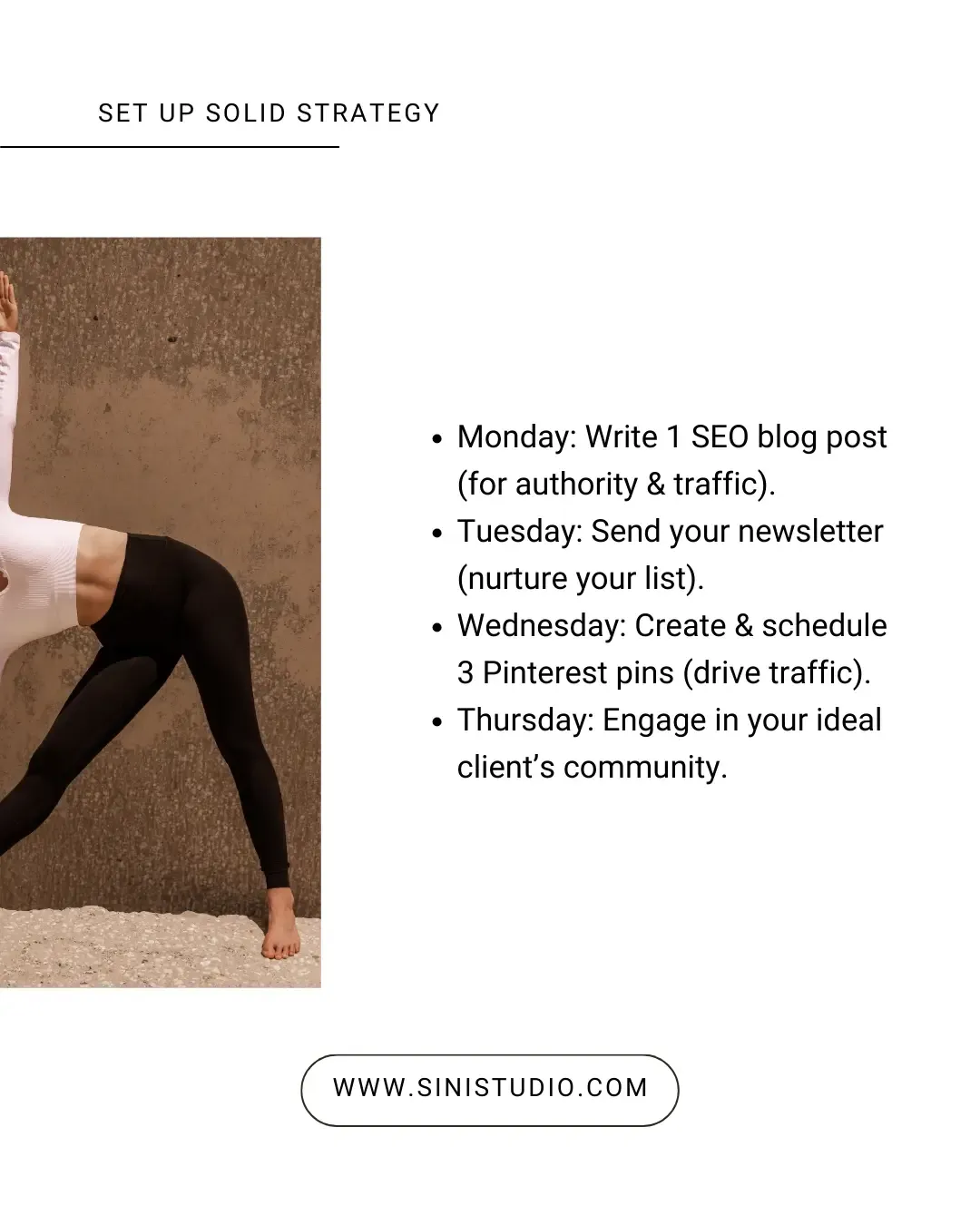
A simple, sustainable starter rhythm could be:
Monday: Write a SEO blog post based on your content pillars. (authority and traffic)
Tuesday: Send your weekly newsletter highlighting the main idea from Monday’s blog post (nurture your list).
Wednesday: Create & schedule 3 Pinterest pins related to the Monday blog (drive traffic).
Thursday: Engage in your ideal client's favourite Facebook group (build community).
3. In the "Way to do" section, name your system. E.g., "The Mindful Marketing Month" or "The Quarterly Focus Sprint."
Step 5C: Fuel It With Your Content Pillars (The 'What' You'll Say)
Your pillars (from your Core Message, Step 3) prevent creator's block. One pillar = endless content.
The content pillars mean the topics you want to become a trusted authority on. They are the topics you constantly want to learn more about, share with the world, and your eyes spark when someone asks you to tell more about it. By now, these should already be part of your strategy in step 3 and 4.
Pillar Example for "Sacred Self-Care for Creatives" retreat leader:
Weekly Content: Instagram post on "A ritual to unlock creativity," Pinterest pin linking to a blog "Why artists need retreats," Newsletter story on a client's creative breakthrough.
Pillar Example for mindful business coach on"Sustainable Leadership"
Weekly Content: LinkedIn article on "The CEO's Guide to Nervous System Health," Instagram Reel on a 2-minute breathwork technique for meetings, Blog post on "Preventing Founder Burnout."
Action: In the "Summary of the marketing machine" section, write a short paragraph describing this entire system.
Example:
"My marketing machine runs on a “Mindful Marketing Months” cycles. I focus on SEO blog articles, Pinterest and Email to attract and nurture my ideal clients—creative women seeking permission to pause. Each month, I create content around my three pillars: Sacred Space, Creative Unblocking, and Ritual Renewal. This system ensures I show up consistently without last-minute panic."
This step is the cure for "reinventing the wheel" every single launch. It replaces the exhausting "what should I post?" panic with a calm, pre-defined schedule. Your marketing machine works for you, so you don't have to work for it. It creates the space for you to do what you do best: teach, heal, and transform.
Step 6: Consider Budget & Resources (The Realistic Check)
ALIGN YOUR PLAN WITH YOUR REALITY
A brilliant plan is useless if you don't have the time, money, or energy to execute it. This step is your sustainability check. It’s about being honest with yourself so your marketing plan empowers you instead of becoming another source of guilt.
Use the "Marketing budget and resources" section of your template to make this tangible.
Actionable Guidance to reality-check resources: The Two Key Questions
1. What’s Your Budget?
Your budget isn't just for ads. It’s for freedom. Consider:
Tools & Subscriptions (Canva Pro, email software, website hosting): ~€50-150/month.
Education & Coaching (to fast-track your skills): A one-time or monthly investment.
Outsourcing (technical setup for website, SEO reporting, visuals): The fastest way to buy back your time.
Advertising Budget (Meta/Google/Pinterest ads): Start small: even €5/day can be a test.
If your whole budget goes for Instagram advertising, you will always be stuck on this. You won’t build a sustainable marketing machine that brings leads organically long-term for free if you don’t invest in learning or outsourcing SEO and other bulletproof methods.
(This is the core reason I don’t help with social media marketing, as there are so many better ways to reach your ideal client (provided you first know your ideal customer persona, as taught in step 2). )
If your budget is €0 right now, your primary resource is your time. That's okay. In your template, write: "Current budget: My focused time. I will dedicate 5 hours per week to executing this plan myself."
2. Who’s On Your Team?
You are the CEO. Who supports you?Just you? That's your team. Your role is "Chief Everything Officer."
A virtual assistant? They handle scheduling and graphics.
A mentor or coach? They provide strategy and accountability.
In your template, list these roles. Clarity here prevents the overwhelm of thinking you have to do it all perfectly, alone.
This step directly addresses and removes the feeling of “now I need to become also a full-time marketer on top of my actual healing work with clients”
Realistically checking your resources will force you to remove actions from the marketing machine (step 5) that are not realistic.
Ask yourself:
"Will doing this move me toward my goals, or keep me stuck in busywork?"
“Is this Instagram ad an investment that pays itself off, or is it an expense that brings just “internet points”, like likes, views and comments, but not real leads and clients?”
Checking your time, money and resources helps you prioritize.
For example, investing €100 in a tool that saves you 10 hours a month isn't an expense—it's an investment in your energy and your ability to serve clients. This is how you build a business that supports your life, not consumes it.
On the other hand, investing 100€ and 3 hours a week on Instagram may bring you short-term visibility and “internet points”, as I like to call the Meta’s likes, comments and views that keep us hooked and thinking our content works, but does this 3 hours and 100€ show under the line at the end of the week, or at the end of the year?
This step stops leaking your budget into actions that don't bring a return on investment.
Step 7: Download Your Free Marketing Strategy Template
Okay, I think we have established that you need a strategy.
You’ve just walked through the entire framework. Now, you need the tool to build it.
I’ve turned this complete 9-step process into a plug-and-play Wellness Marketing Strategy Template.
This isn't a generic document. It contains the exact sections and guiding questions we covered, structured in the logical order you need:
Business Objectives & SMART KPIs
Clarity on Your Ideal Client: Go beyond demographics, like "30-50y women", to their desires and pains.
Your Core Message Pillar: The one transformation you offer.
It sounds restricting, but trust me: with one main promise and message, you have so much more to say.Your Content & Channel Focus: Where to show up without spreading yourself thin.
Should you focus on Pinterest SEO or Instagram Reels? Once you know who you want to reach, you can define where to reach them best.Your simple weekly and monthly marketing plan
Map out a basic weekly and monthly rhythm so you never have to wonder "what should I post?" again. This will also give you an overview to see if your new, fancy plan is realistic. In reality, this means maybe not planning to post every single day, but rather once a week, but with a clear message in carefully chosen platform that you can build on consistently.Budget & Resources
IDEAL CUSTOMER PERSONA | KPIS | MARKETING MACHINE
WELLNESS MARKETING STRATEGY
TEMPLATE
THE BLUEPRINT THAT MOVES YOU FROM THEORY TO ACTION.
Download a free template to help you create a working marketing strategy for wellness marketing.
The tool will help you take into account everything that is essential to set up succesful marketing strategy for a wellness business.
This product will be delivered via email.
Double check your email address is correct before hitting submit.


13
Essential sections
By order this free wellness marketing strategy template, you join SINI STUDIO Newsletter. Unsubscribe anytime.
After You Fill This Out, Your Marketing Changes
Download the template, open it, and start filling it out as you re-read this guide.
Stop the cycle of planning in your head. Put it on paper and make it real.
Writing captions becomes easier because you know who you're talking to.
Planning content becomes faster because you have your pillars.
You feel a sense of calm direction instead of reactive panic.
Stop the cycle of random acts of marketing.
Your first step towards a calm, clear, and effective presence is one page away.
If you fill this out and still feel lost:
Book a free, no-pressure call with me to get the first three steps of clarity on your wellness marketing.
Once your strategy is clear, the next step is building the digital home it deserves: a website that converts your clarity into clients. If you’re ready to explore that, I invite you to learn about the Sanctuary Setup or book a free clarity call.

Discover more free tips about
Or read the latest free tips in SINI STUDIO:
TIPS TO SELL RELAXATION AND MEMORIES
WELLNESS TRAVEL MARKETING THAT TELLS AND SELLS