
Why Your Yoga Class Descriptions Aren't Working + How to Fix It
Written by: Sini Hietaharju, Wellness Travel Marketing Specialist
This post is part of
series
You've planned the perfect sequence. You've arrived early, lit the candles, and set up your props. The room is ready.
But only three students show up.
You know your class is good.
The regulars who come love it.
So why aren't more people booking?
The answer might be hiding in plain sight: your class description.
What's Wrong with Most Yoga Class Descriptions
Here's what most yoga class descriptions look like:
"Hatha Yoga: A slower-paced class focusing on holding postures to build strength, balance, and alignment."
"Vinyasa Flow: A vigorous yoga style based on a series of poses performed in a rapid dance-like flow. Attention is given to connecting each movement to the breath."
"Yin Yoga: A slow, soothing, and meditative style that targets the deep connective tissues, bones, joints, fascia, and ligaments."
These aren't wrong. They're accurate. They're informative.
But they're also forgettable.
They read like textbook definitions. And here's what happens when a potential student reads them:
What the yoga class description says:
How your potential yoga student reads it:
Weekly Vinyasa Flow for all levels. Focus on alignment.
"Okay... but will this help with my back pain? Do I need to be flexible? Will I fit in? Is this too hard for me? Too easy? I'll just scroll."
The hard truth: Your students don't want a definition.
They want to know if this class is for them.
They want to know how they'll feel when it's over.
And right now, most class descriptions never tell them.
Easiest way to do this is by downloading this Google Doc template that you can just fill in.
This is your guide to write yoga class descriptions that sell.
Discover also the earlier Pillars from wellness marketing foundation and strategy:
Pillar 1: How to create a marketing plan for a wellness business
Pillar 2: How to Define your Wellness Client Persona in 3 simple steps
PART 1: UNDERSTANDING THE PROBLEM
Why Your Yoga Copy Isn't Connecting
Why Yoga Teachers Struggle with Class Descriptions
If this is so important, why do so many yoga teachers get it wrong?
Three reasons:
1. The Curse of Knowledge
You know so much about yoga that you've forgotten what it's like to not know. Words like "asana," "pranayama," and "drishti" are second nature to you. But to a nervous beginner, they sound like a foreign language.
2. The Sanskrit Trap
Somewhere along the way, we started believing that using Sanskrit and technical terms makes us sound more legitimate. It doesn't. It makes us sound less accessible.
3. The Feature Habit
When you've been trained to think about alignment, sequencing, and proper cueing, it's natural to describe your class by what you'll do. But students don't care about what they'll do—they care about how they'll feel.
Common yoga teacher fears:
"If I don't use proper terminology, will I sound legit?"
"What if I promise a feeling and the student doesn't experience it?"
"I don't want to sound like I'm selling something."
Clear, relatable descriptions give students the information they need to choose the right class for their body and their needs.
What Your Students Are Really Looking For
Let's be honest about why people sign up for yoga.
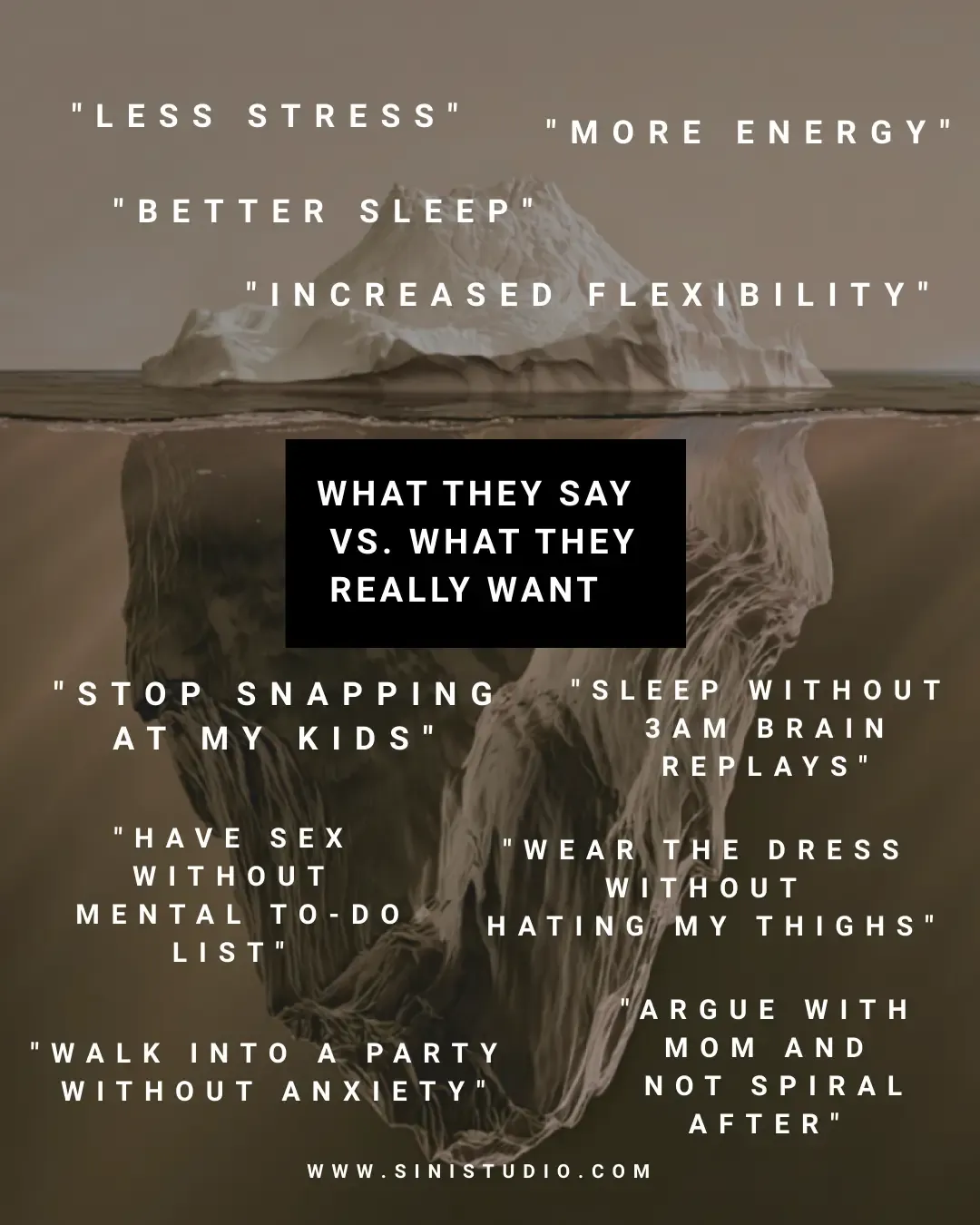
Sure, they might say "I want to get more flexible" or "I need to reduce stress." But those are surface answers. The real reasons live deeper.
Every student walking into your studio has three unspoken questions:
Will I fit in here? (Am I too old? Too inflexible? Too inexperienced?)
Will this work for my body? (Will I hurt? Will I be able to keep up?)
How will I feel when I leave? (Will I finally relax? Will my back stop hurting? Will I sleep better tonight?)
Your class description needs to answer these questions—whether the student consciously asks them or not.
Let's look at example:
"Hatha Yoga classes are slower moving, poses are held longer and the focus on deep stretching and strengthening. Hatha Yoga is very grounding and increases focus and stamina."
What this does well: It sets clear expectations about pace.
What it misses: What does "grounding" actually feel like in a Tuesday evening? What does "increased stamina" get them in real life? Does it mean they won't be exhausted after work? Does it mean they'll have energy to play with their kids?
"A challenging class to increase fitness, strength and stamina, Power Vinyasa is a class that blends a breath to movement practice. It is a full body flow that builds core strength which helps to improve posture."
The gap: "Improve posture" is a benefit. But what does improved posture feel like?
Less back pain at work?
Standing taller in meetings?
Finally comfortable in your body?
Your partner commenting that you seem more confident?
Your students aren't buying yoga. They're buying the feeling of being someone who does yoga.
Instead of this:
Try this:
"Pranayama practices"
"Breathwork to calm your nervous system"
"Access your bandhas"
"Engage your core for stability"
"Cultivate tapas"
"Build a practice that actually sticks"
"Open your heart center"
"Release tension across your chest and shoulders"
"Find your drishti"
"Pick a spot to focus your gaze—it helps with balance"
What if your students are more advanced and prefer using these Sanskrit words I told above not to use? This is why it all comes down to knowing your ideal customer persona. Only then you can talk to them with words that resonate.
You can also teach beginners some Sanskrit words, as long as sounding legitimate is not the point, but to be understood and teach your students
PART 2: THE SOLUTION
Your Framework for Yoga Class Descriptions That Connect
The Yoga Description Framework – Real-life Yoga Class Descriptions Examples
After analysing hundreds of class descriptions and what actually makes students book, one simple formula keeps emerging.
The Four-Step Framework:
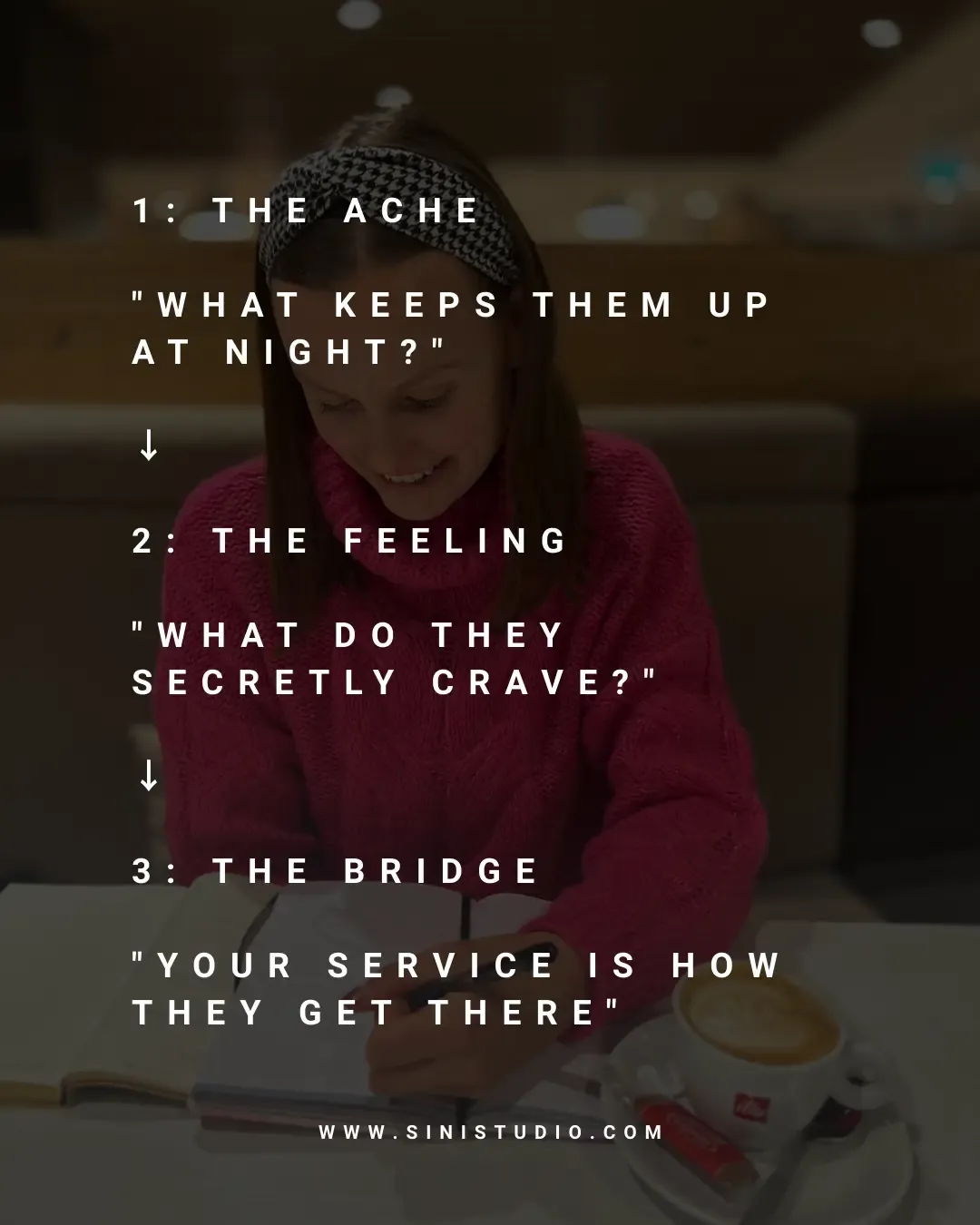
[WHO] this class is for, who feels [BEFORE ACHE] .
We'll [WHAT YOU'LL DO] so you can leave [AFTER FEELING] .
[WHAT MAKES IT YOURS] .
Let's break it down with real-life yoga class description ideas.
Easiest way to do this is by downloading this Google Doc template that you can just fill in.
Step 1: WHO – Be specific, even for "all levels"

Vague: "All levels welcome."
Specific: "Perfect if you've never done yoga before—or if you're returning after a long break."
Vague: "For everyone."
Specific: "For anyone who sits at a desk all day and needs to unlock tight hips."
The paradox: When you get specific about who the class is for, the right students feel more welcome, not less. They think "that's me!" instead of "I hope I'm welcome there."
Step 2: BEFORE – Name the ache they're carrying

Vague: "Release stress."
Specific: "If your mind is still running through your to-do list at 11pm..."
Vague: "Relieve tension."
Specific: "That nagging tightness between your shoulder blades that never quite goes away."
This is where they think: "Wait, is she talking about me?"
Step 3: DO – What will actually happen?

This is where your features live—but framed as the path to the feeling, not the destination itself.
Vague: "We'll hold poses for 3-5 minutes."
Specific: "We'll settle into long, supported holds so you can sink into the stretch instead of fighting for it."
Vague: "Focus on alignment."
Specific: "We'll move slowly, with plenty of cues, so you know exactly where your feet should go."
Step 4: AFTER – How will they feel when they leave?

This is your promise. Make it specific and honest.
Vague: "Leave feeling refreshed."
Specific: "Walk out standing taller, breathing easier, and finally comfortable in your body."
Vague: "Feel renewed."
Specific: "Leave feeling like you've had a nap for your nervous system."
Step 5: YOU – What makes your class different?

This is where you shine. Your training. Your philosophy. Your vibe.
Example: "With 10 years of experience working with back pain, I'll offer modifications you won't get anywhere else."
Example: "We keep the room warm, the music good, and the judgment left at the door."
Put it all together: yoga class written out
"This class is for anyone who sits at a desk all day and wants to release that nagging lower back tension.
We'll move through gentle standing poses and hip openers, holding them long enough to really melt the tightness.
With 10 years of experience working with desk workers, I'll show you exactly how to undo the damage of sitting.
You'll walk out standing taller, breathing easier, and finally comfortable in your body."
This framework works for every class—from gentle to power, beginner to advanced.
Write up for yoga class– Translated for Real Humans
Let's apply this framework to the most common class types.
Use these as inspiration for your own descriptions.
Beginner yoga class description
Generic
Written with the framework
"An introductory class for students new to Yoga. Learn basic yoga postures in a clear, safe and practical manner."
"Never done yoga? Perfect.
This class assumes you know absolutely nothing—and we love that.
We'll start at the very beginning: what to do with your feet, how to breathe when things get challenging, and all those pose names you've forgotten.
No flexibility required. No experience needed.
Just a body and curiosity. You'll leave knowing the basics—and wondering why you were nervous at all."
Vinyasa Flow yoga class description
Generic
Written with the framework
"A vigorous Yoga style, based on a series of poses performed in rapid dance-like flow. Attention is given to connecting each movement to the breath."
If your mind won't stop racing, this class gives it something to focus on.
We move breath-to-movement through continuous sequences—so you're too present to think about your to-do list, your emails, or that thing you said in 2019.
You'll build heat, strength, and the glorious feeling of being in your body instead of in your head.
Leave sweaty, centered, and blissfully empty-headed.
Yin Yoga class description
Generic
Written with the framework
"A slow, soothing, and meditative style of yoga that targets the deep connective tissues, bones, joints, fascia, and ligaments in the body."
Finally, permission to do nothing.
We'll use props to support your body in poses held for 3-5 minutes, so you can sink into the stretch instead of muscling through it.
This is for anyone who's tired of doing—and ready to just be.
Leave feeling like you've had a massage from the inside out. Your nervous system will thank you.
Restorative yoga class description
Generic
Written with the framework
No generic found—because most studios don't know how to describe this one either.
The only thing you'll work on in this class is relaxing.
We use bolsters, blankets, and blocks to support your body in restful poses, so you don't have to hold anything.
It's like being tucked into bed by someone who cares.
Perfect for burnout, insomnia, grief, or those weeks when life feels like too much.
Leave feeling held, rested, and a little bit more like yourself.
Power Yoga / Yoga Sculpt class description
Generic
Written with the framework
"Combines the benefits of traditional yoga poses with weight training. Using light weights and slow breath controlled movements this class will increase strength and flexibility."
Want to feel strong and sweaty?
This class adds light weights to yoga flow so you build lean muscle while you move.
Don't worry—you can go at your own pace, and modifications are always offered.
Leave feeling capable, accomplished, and pleasantly tired in the best way. Your muscles will remember this tomorrow.
Prenatal yoga class description
Generic
Written with the framework
"Specialized yoga for pregnant individuals to build strength and prepare for childbirth."
Created for pregnant bodies and the changes they're experiencing.
We'll focus on breath, pelvic floor awareness, and poses that create space and ease—physically and emotionally.
All trimesters welcome. No yoga experience needed—just a body doing an amazing thing.
Come connect with other pregnant people and remember that you're not alone in this.
Yoga for Athletes class description
Generic
Written with the framework
Often missing entirely
You push hard in your sport.
This class helps you recover so you can push again tomorrow.
We'll focus on opening hips, stretching hamstrings, and releasing the tight spots that hold you back.
Think of it as maintenance for your most important equipment: your body. Leave feeling longer, looser, and ready for your next workout.
Gentle yoga class description
Generic
Written with the framework
"A slower-paced class with gentle movements."
Start your day without rushing.
This class moves at a pace that lets you actually feel each pose—no frantic vinyanas here. We'll coordinate breath with simple movements so you leave energized but not exhausted.
Perfect for mornings when you need to ease in, not jump-start. Also great for anyone recovering from injury or just craving a softer approach.
Steal these. Adapt them. Make them yours. The framework works for every class you teach.
PUTTING IT INTO PRACTICE
From Your Mat to Your Marketing
Your Action Step – The Yoga Class Description Rewrite Exercise
The ones who are ready to take action, get the free template that you can sipmly fill in to rewrite all your Yoga Class Descriptions to sell.
Available as a Google Docs and a PDF download.
Where to Use Your New Descriptions
Once you've rewritten your class descriptions, use them everywhere.
Website Class Schedule
Use your full description on individual class pages. Include:
The who, before, do, after, you framework
What to bring (mat, water, props)
Any prerequisites (none for most classes!)
Teacher name and photo
Schedule Grid / App
Space is tight here. Use the short version:
Gentle flow for desk workers. Release tight shoulders. All levels.
Power yoga. Build strength and sweat. Modifications offered.
Lead with the ache, offer the feeling.
You know that feeling when you've been sitting all day and your shoulders are just... done?
This class is the antidote. Link in bio.
Email Newsletter
Share a personal story about why you love teaching this class, then invite them to join.
Subject: The class I created for my own stiff shoulders
I used to wake up every morning with knots between my shoulder blades that wouldn't quit. Turns out, 8 hours at a computer will do that.
So I created a class specifically for desk workers—and it changed everything.
[Class Name] is designed to undo the damage of sitting. We move slowly, stretch deeply, and by the end, you remember what it feels like to actually relax.
Join me [day/time]. Your shoulders will thank you.
Google Business Profile
Use keywords + the short version:
Gentle yoga for desk workers and beginners. Release tight shoulders and improve posture. All levels welcome. Book online.
Flyers / Posters
Big hook. Short description. Clear call to action.
TIRED OF TIGHT SHOULDERS?
Gentle yoga for desk workers.
Wednesdays 6pm | Studio 2
First class free for new students.
[QR code to book]
Class Directories (Mindbody, etc.)
Use your full description with keywords naturally included.
Get your free yoga copy fill-in-the-blanks template
What's inside the workbook:
✅ The Class Description Generator – Fill-in-the-blanks template
✅ The "Who Are You Teaching?" Clarifier – Get specific about your ideal student so every word lands
Ready to Stop Writing Generic Class Descriptions?
Frequently Asked Questions about Yoga Class Descriptions
Most advice tells you to "include keywords" or "list benefits." This framework shows you how to translate what you do into how your students actually feel—in their language, about their real lives. It's not about writing better sentences. It's about fundamentally shifting how you think about your classes.
No. You'll likely keep 70% of what you have. You're just adding the missing piece: the emotional bridge between what you offer and why it matters. Most of your current content is still valuable—it just needs to follow the feeling, not lead with features.
Share this article with your studio manager. Offer to rewrite your own class descriptions. Most studio owners are too busy to focus on copy—they'll likely welcome the help. And if they say no, you can still use this framework for your own marketing, social media, and emails.
The initial rewrite for one class takes about 15 minutes using the template
This framework is designed for non-writers. You don't need to be good at writing—you just need to be honest about how your classes feel and who they're for. The templates do the rest.
This framework works for online classes too—maybe even better. Online students can't see the studio or feel the vibe in person. Your description has to do even more work to help them imagine the experience.
Yes! Once you have filled in the workbook, you can email sini@sinistudio.com to hear my honest feedback!
PART 5: LET'S DO IT
Ready to Stop Wrestling with Words?
Discover more free tips about
Or read the latest free tips in SINI STUDIO:
TIPS TO SELL RELAXATION AND MEMORIES
WELLNESS TRAVEL MARKETING THAT TELLS AND SELLS